

How To Make A Camera Obscura Tent

The history of photography began in remote antiquity with the discovery of ii critical principles: camera obscura image projection and the observation that some substances are visibly altered past exposure to light. There are no artifacts or descriptions that indicate any attempt to capture images with calorie-free sensitive materials prior to the 18th century.
Around 1717, Johann Heinrich Schulze captured cut-out messages on a canteen of a light-sensitive slurry, but he apparently never thought of making the results durable. Around 1800, Thomas Wedgwood fabricated the first reliably documented, although unsuccessful attempt at capturing photographic camera images in permanent form. His experiments did produce detailed photograms, but Wedgwood and his associate Humphry Davy constitute no way to set these images.
In the mid-1820s, Nicéphore Niépce starting time managed to fix an paradigm that was captured with a photographic camera, but at least eight hours or even several days of exposure in the camera were required and the earliest results were very rough. Niépce'southward associate Louis Daguerre went on to develop the daguerreotype procedure, the starting time publicly announced and commercially viable photographic process. The daguerreotype required just minutes of exposure in the photographic camera, and produced articulate, finely detailed results. The details were introduced to the world in 1839, a appointment mostly accepted as the nascence year of applied photography.[ii] [3] The metal-based daguerreotype process before long had some competition from the paper-based calotype negative and salt print processes invented by William Henry Fox Talbot and demonstrated in 1839 soon afterward news most the daguerreotype reached Talbot. Subsequent innovations made photography easier and more versatile. New materials reduced the required photographic camera exposure fourth dimension from minutes to seconds, and eventually to a modest fraction of a 2nd; new photographic media were more economic, sensitive or convenient. Since the 1850s, the collodion process with its glass-based photographic plates combined the loftier quality known from the Daguerreotype with the multiple impress options known from the calotype and was commonly used for decades. Roll films popularized coincidental use by amateurs. In the mid-20th century, developments fabricated it possible for amateurs to take pictures in natural colour likewise as in black-and-white.
The commercial introduction of reckoner-based electronic digital cameras in the 1990s soon revolutionized photography. During the first decade of the 21st century, traditional film-based photochemical methods were increasingly marginalized equally the practical advantages of the new technology became widely appreciated and the image quality of moderately priced digital cameras was continually improved. Especially since cameras became a standard characteristic on smartphones, taking pictures (and instantly publishing them online) has become a ubiquitous everyday exercise effectually the world.
Etymology [edit]
The coining of the word "photography" is ordinarily attributed to Sir John Herschel in 1839. Information technology is based on the Greek φῶς (phōs; genitive phōtos), meaning "calorie-free", and γραφή (graphê), meaning "drawing, writing", together significant "drawing with low-cal".[4]
Early on history of the photographic camera [edit]
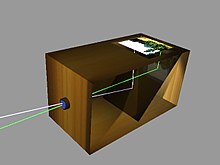
Principle of a box camera obscura with mirror
A natural miracle, known as photographic camera obscura or pinhole prototype, tin can project a (reversed) prototype through a modest opening onto an reverse surface. This principle may have been known and used in prehistoric times. The earliest known written record of the camera obscura is to be institute in Chinese writings by Mozi, dated to the quaternary century BCE.[5] Until the 16th century the photographic camera obscura was mainly used to study optics and astronomy, especially to safely spotter solar eclipses without damaging the eyes. In the later half of the 16th century some technical improvements were developed: a biconvex lens in the opening (kickoff described by Gerolamo Cardano in 1550) and a diaphragm restricting the aperture (Daniel Barbaro in 1568) gave a brighter and sharper image. In 1558 Giambattista della Porta brash using the camera obscura as a drawing aid in his popular and influential books. Della Porta's advice was widely adopted by artists and since the 17th century portable versions of the photographic camera obscura were commonly used — showtime every bit a tent, later every bit boxes. The box blazon camera obscura was the basis for the primeval photographic cameras when photography was adult in the early on 19th century.[6]
Earlier 1700: Light sensitive materials [edit]
The notion that light can affect various substances — for instance, the sunday tanning of skin or fading of textile — must take been around since very early times. Ideas of fixing the images seen in mirrors or other means of creating images automatically may also have been in people'southward minds long earlier anything like photography was developed.[7] However, there seem to be no historical records of whatever ideas fifty-fifty remotely resembling photography earlier 1700, despite early knowledge of light-sensitive materials and the camera obscura.[8]
In 1614 Angelo Sala noted that[9] sunlight volition plow powdered silver nitrate black, and that newspaper wrapped around silverish nitrate for a year will turn blackness.[x]
Wilhelm Homberg described how calorie-free darkened some chemicals in 1694.[11]
1700 to 1802: primeval concepts and fleeting photogram results [edit]
Schulze's Scotophors: primeval fleeting letter photograms (circa 1717) [edit]
Around 1717,[12] German polymath Johann Heinrich Schulze accidentally discovered that a slurry of chalk and nitric acid into which some silvery particles had been dissolved was darkened by sunlight. Later experiments with threads that had created lines on the bottled substance later he placed it in direct sunlight for a while, he practical stencils of words to the bottle. The stencils produced copies of the text in dark ruby, almost violet characters on the surface of the otherwise whitish contents. The impressions persisted until they were erased by shaking the canteen or until overall exposure to light obliterated them. Schulze named the substance "Scotophors" when he published his findings in 1719. He thought the discovery could be applied to detect whether metals or minerals contained any silvery and hoped that farther experimentation by others would lead to another useful results.[13] [xiv] Schulze's process resembled later photogram techniques and is sometimes regarded equally the very showtime form of photography.[fifteen]
De la Roche'southward fictional image capturing process (1760) [edit]
The early science fiction novel Giphantie [16] (1760) by the Frenchman Tiphaigne de la Roche described something quite similar to (color) photography, a process that fixes fleeting images formed by rays of light: "They coat a piece of canvass with this cloth, and place information technology in front of the object to capture. The first upshot of this cloth is like to that of a mirror, just by ways of its mucilaginous nature the prepared canvas, as is not the example with the mirror, retains a facsimile of the epitome. The mirror represents images faithfully, but retains none; our canvass reflects them no less faithfully, just retains them all. This impression of the epitome is instantaneous. The sheet is then removed and deposited in a dark place. An hour later the impression is dry, and you have a picture the more precious in that no art tin can imitate its truthfulness."[17] De la Roche thus imagined a process that made apply of a special substance in combination with the qualities of a mirror, rather than the camera obscura. The hour of drying in a nighttime identify suggests that he perhaps thought nearly the light sensitivity of the cloth, simply he attributed the issue to its viscous nature.
Scheele's forgotten chemical fixer (1777) [edit]
In 1777, the chemist Carl Wilhelm Scheele was studying the more intrinsically light-sensitive silver chloride and determined that light darkened information technology past disintegrating information technology into microscopic nighttime particles of metallic silver. Of greater potential usefulness, Scheele found that ammonia dissolved the silvery chloride, but not the night particles. This discovery could have been used to stabilize or "set" a photographic camera paradigm captured with silvery chloride, only was not picked upwardly past the earliest photography experimenters.[eighteen]
Scheele also noted that ruddy light did not have much consequence on silver chloride, a miracle that would later be applied in photographic darkrooms equally a method of seeing black-and-white prints without harming their development.[nineteen]
Although Thomas Wedgwood felt inspired by Scheele's writings in general, he must accept missed or forgotten these experiments; he found no method to fix the photogram and shadow images he managed to capture effectually 1800 (see below).[xix]
Elizabeth Fulhame and the issue of light on silverish salts (1794) [edit]
Elizabeth Fulhame's volume An essay on combustion [20] described her experiments of the effects of light on silver salts. She is better known for her discovery of what is now called catalysis, but Larry J. Schaaf in his history of photography[21] [22] considered her work on silver chemical science to represent a major pace in the development of photography.
Thomas Wedgwood and Humphry Davy: Fleeting detailed photograms (1790?–1802) [edit]
English lensman and inventor Thomas Wedgwood is believed to have been the first person to have thought of creating permanent pictures by capturing camera images on fabric coated with a light-sensitive chemical. He originally wanted to capture the images of a camera obscura, only found they were too faint to take an outcome upon the silver nitrate solution that was recommended to him every bit a light-sensitive substance. Wedgwood did manage to copy painted glass plates and captured shadows on white leather, as well as on paper moistened with a silverish nitrate solution. Attempts to preserve the results with their "distinct tints of brown or black, sensibly differing in intensity" failed. It is unclear when Wedgwood'due south experiments took place. He may accept started before 1790; James Watt wrote a letter to Thomas Wedgwood's begetter Josiah Wedgwood to give thanks him "for your instructions as to the Silvery Pictures, well-nigh which, when at home, I volition brand some experiments". This letter (now lost) is believed to have been written in 1790, 1791 or 1799. In 1802, an account by Humphry Davy detailing Wedgwood's experiments was published in an early journal of the Royal Institution with the title An Account of a Method of Copying Paintings upon Glass, and of Making Profiles, by the Agency of Light upon Nitrate of Silvery. Davy added that the method could be used for objects that are partly opaque and partly transparent to create accurate representations of, for instance, "the woody fibres of leaves and the wings of insects". He also found that solar microscope images of pocket-size objects were hands captured on prepared paper. Davy, apparently unaware or forgetful of Scheele's discovery, concluded that substances should be found to eliminate (or deactivate) the unexposed particles in silver nitrate or silver chloride "to render the procedure as useful every bit it is elegant".[19] Wedgwood may have prematurely abandoned his experiments considering of his frail and failing health. He died at age 34 in 1805.
Davy seems non to have continued the experiments. Although the periodical of the nascent Imperial Establishment probably reached its very small group of members, the article must accept been read eventually by many more than people. It was reviewed by David Brewster in the Edinburgh Magazine in December 1802, appeared in chemistry textbooks equally early every bit 1803, was translated into French and was published in German in 1811. Readers of the commodity may have been discouraged to discover a logroller, because the highly acclaimed scientist Davy had already tried and failed. Apparently the commodity was not noted past Niépce or Daguerre, and by Talbot only after he had developed his own processes.[19] [23]
Jacques Charles: Fleeting silhouette photograms (circa 1801?) [edit]
French balloonist, professor and inventor Jacques Charles is believed to take captured fleeting negative photograms of silhouettes on light-sensitive paper at the start of the 19th century, prior to Wedgwood. Charles died in 1823 without having documented the process, but purportedly demonstrated information technology in his lectures at the Louvre. Information technology was not publicized until François Arago mentioned it at his introduction of the details of the daguerreotype to the globe in 1839. He later wrote that the get-go thought of fixing the images of the camera obscura or the solar microscope with chemical substances belonged to Charles. Later historians probably only built on Arago's information, and, much subsequently, the unsupported year 1780 was attached to it.[24] As Arago indicated the first years of the 19th century and a date prior to the 1802 publication of Wedgwood's process, this would hateful that Charles' demonstrations took place in 1800 or 1801, assuming that Arago was this accurate near 40 years subsequently.
1816 to 1833: Niépce'due south earliest fixed images [edit]
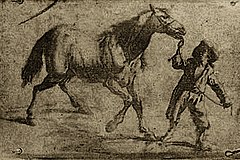
The earliest known surviving heliographic engraving, made in 1825. Information technology was printed from a metal plate fabricated by Joseph Nicéphore Niépce with his "heliographic procedure".[25] The plate was exposed nether an ordinary engraving and copied it past photographic ways. This was a step towards the first permanent photograph from nature taken with a camera obscura.

The Boulevard du Temple, a daguerreotype made by Louis Daguerre in 1838, is generally accepted equally the primeval photograph to include people. It is a view of a decorated street, but because the exposure lasted for several minutes the moving traffic left no trace. But the 2 men virtually the bottom left corner, one of them apparently having his boots polished by the other, remained in one place long enough to exist visible.
In 1816, Nicéphore Niépce, using newspaper coated with silver chloride, succeeded in photographing the images formed in a small camera, but the photographs were negatives, darkest where the camera paradigm was lightest and vice versa, and they were not permanent in the sense of being reasonably light-fast; like before experimenters, Niépce could notice no style to prevent the coating from darkening all over when it was exposed to light for viewing. Disenchanted with silver salts, he turned his attention to calorie-free-sensitive organic substances.[26]
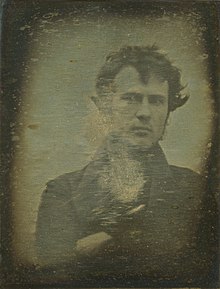
Robert Cornelius, self-portrait, Oct or November 1839, an approximately quarter plate size daguerreotype. On the dorsum is written, "The beginning light flick e'er taken".

I of the oldest photographic portraits known, 1839 or 1840,[27] made past John William Draper of his sister, Dorothy Catherine Draper

Daguerreotype Of Dr John William Draper at NYU in the autumn of 1839, sitting with his plant experiment and pen in hand. Possibly past Samuel Morse.

The oldest surviving photograph of the prototype formed in a camera was created by Niépce in 1826 or 1827.[2] It was made on a polished sheet of pewter and the light-sensitive substance was a sparse coating of bitumen, a naturally occurring petroleum tar, which was dissolved in lavander oil, applied to the surface of the pewter and allowed to dry out before use.[28] Later a very long exposure in the camera (traditionally said to exist eight hours, but now believed to exist several days),[29] the bitumen was sufficiently hardened in proportion to its exposure to light that the unhardened function could be removed with a solvent, leaving a positive epitome with the light areas represented by hardened bitumen and the dark areas by bare pewter.[28] To come across the image plainly, the plate had to be lit and viewed in such a fashion that the bare metallic appeared dark and the bitumen relatively low-cal.[26]
In partnership, Niépce in Chalon-sur-Saône and Louis Daguerre in Paris refined the bitumen procedure,[30] substituting a more sensitive resin and a very different post-exposure handling that yielded college-quality and more easily viewed images. Exposure times in the camera, although substantially reduced, were notwithstanding measured in hours.[26]
1832 to 1840: early monochrome processes [edit]
Niépce died of a sudden in 1833, leaving his notes to Daguerre. More interested in silvery-based processes than Niépce had been, Daguerre experimented with photographing camera images directly onto a mirror-similar silver-surfaced plate that had been fumed with iodine vapor, which reacted with the silver to form a coating of silvery iodide. Equally with the bitumen process, the result appeared as a positive when information technology was suitably lit and viewed. Exposure times were nonetheless impractically long until Daguerre made the pivotal discovery that an invisibly slight or "latent" image produced on such a plate by a much shorter exposure could be "developed" to full visibility by mercury fumes. This brought the required exposure time down to a few minutes under optimum conditions. A potent hot solution of common table salt served to stabilize or set the epitome past removing the remaining silver iodide. On 7 January 1839, this first complete applied photographic procedure was announced at a meeting of the French Academy of Sciences,[31] and the news speedily spread.[32] At first, all details of the process were withheld and specimens were shown only at Daguerre's studio, under his close supervision, to Academy members and other distinguished guests.[33] Arrangements were made for the French government to buy the rights in exchange for pensions for Niépce's son and Daguerre and present the invention to the world (with the exception of Groovy Britain, where an agent for Daguerre patented it) as a free gift.[34] Complete instructions were made public on 19 August 1839.[35] Known equally the daguerreotype process, it was the most common commercial process until the late 1850s when it was superseded by the collodion process.
French-born Hércules Florence developed his ain photographic technique in [36] in 1832 or 1833 with some help of pharmacist Joaquim Corrêa de Mello (1816–1877). Looking for some other method to copy graphic designs he captured their images on newspaper treated with silver nitrate equally contact prints or in a photographic camera obscura device. He did not manage to properly prepare his images and abased the project after hearing of the Daguerreotype process in 1839[37] and didn't properly publish any of his findings. He reportedly referred to the technique as "photographie" (in French) as early as 1833, too helped by a suggestion of De Mello.[38] Some extant photographic contact prints are believed to have been made in circa 1833 and kept in the collection of IMS.
Henry Pull a fast one on Talbot had already succeeded in creating stabilized photographic negatives on paper in 1835, but worked on perfecting his own procedure after reading early reports of Daguerre's invention. In early 1839, he acquired a key comeback, an effective fixer, from his friend John Herschel, a polymath scientist who had previously shown that hyposulfite of soda (commonly called "hypo" and at present known formally as sodium thiosulfate) would deliquesce silver salts.[39] News of this solvent also benefited Daguerre, who shortly adopted it as a more efficient alternative to his original hot salt water method.[twoscore]

Talbot'due south early on silver chloride "sensitive paper" experiments required camera exposures of an hour or more. In 1841, Talbot invented the calotype process, which, like Daguerre's process, used the principle of chemic evolution of a faint or invisible "latent" image to reduce the exposure time to a few minutes. Paper with a coating of silver iodide was exposed in the camera and developed into a translucent negative prototype. Dissimilar a daguerreotype, which could only be copied by photographing it with a photographic camera, a calotype negative could exist used to make a big number of positive prints by elementary contact printing. The calotype had yet another distinction compared to other early photographic processes, in that the finished production lacked fine clarity due to its translucent paper negative. This was seen as a positive attribute for portraits because information technology softened the advent of the human face[ citation needed ]. Talbot patented this process,[41] which profoundly limited its adoption, and spent many years pressing lawsuits against alleged infringers. He attempted to enforce a very wide estimation of his patent, earning himself the ill volition of photographers who were using the related glass-based processes subsequently introduced by other inventors, simply he was eventually defeated. Nonetheless, Talbot's developed-out silvery halide negative process is the basic technology used by chemical motion picture cameras today. Hippolyte Bayard had likewise developed a method of photography only delayed announcing it, and then was not recognized as its inventor.
In 1839, John Herschel made the first glass negative, but his process was difficult to reproduce. Slovenian Janez Puhar invented a process for making photographs on drinking glass in 1841; it was recognized on June 17, 1852 in Paris by the Académie National Agricole, Manufacturière et Commerciale.[42] In 1847, Nicephore Niépce's cousin, the chemist Niépce St. Victor, published his invention of a process for making glass plates with an albumen emulsion; the Langenheim brothers of Philadelphia and John Whipple and William Breed Jones of Boston too invented workable negative-on-glass processes in the mid-1840s.[43]
1850 to 1900 [edit]
In 1851, English sculptor Frederick Scott Archer invented the collodion process.[44] Photographer and children's author Lewis Carroll used this process. (Carroll refers to the process every bit "Talbotype" in the story "A Photographer'southward Solar day Out".)[45]
Herbert Bowyer Berkeley experimented with his own version of collodion emulsions after Samman introduced the idea of adding dithionite to the pyrogallol developer.[ citation needed ] Berkeley discovered that with his ain add-on of sulfite, to absorb the sulfur dioxide given off by the chemical dithionite in the programmer, dithionite was non required in the developing process. In 1881, he published his discovery. Berkeley's formula independent pyrogallol, sulfite, and citric acid. Ammonia was added just before use to make the formula alkaline. The new formula was sold by the Platinotype Company in London as Sulphur-Pyrogallol Developer.[46]
Nineteenth-century experimentation with photographic processes frequently became proprietary. The German-born, New Orleans photographer Theodore Lilienthal successfully sought legal redress in an 1881 infringement case involving his "Lambert Process" in the Eastern District of Louisiana.
-

Roger Fenton'south assistant seated on Fenton's photographic van, Crimea, 1855
-
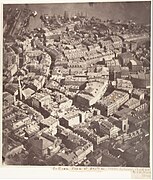
Boston, as the Eagle and the Wild Goose See It, past J.W. Blackness, the first recorded aerial photograph, 1860
-
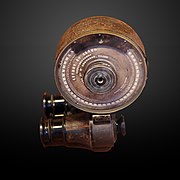
The 1866 "Jumelle de Nicour", an early attempt at a small-format, portable photographic camera
Popularization [edit]
The daguerreotype proved popular in response to the demand for portraiture that emerged from the middle classes during the Industrial Revolution.[47] [ citation needed ] This demand, which could not be met in volume and in cost by oil painting, added to the button for the development of photography.
Roger Fenton and Philip Henry Delamotte helped popularize the new manner of recording events, the first by his Crimean War pictures, the 2d past his record of the disassembly and reconstruction of The Crystal Palace in London. Other mid-nineteenth-century photographers established the medium every bit a more than precise means than engraving or lithography of making a record of landscapes and compages: for example, Robert Macpherson's broad range of photographs of Rome, the interior of the Vatican, and the surrounding countryside became a sophisticated tourist's visual tape of his own travels.
In 1839, François Arago reported the invention of photography to stunned listeners by displaying the starting time photograph taken in Arab republic of egypt; that of Ras El Tin Palace.[48]
In America, by 1851 a broadsheet past daguerreotypist Augustus Washington was advert prices ranging from 50 cents to $10.[49] However, daguerreotypes were fragile and difficult to re-create. Photographers encouraged chemists to refine the procedure of making many copies cheaply, which eventually led them dorsum to Talbot's process.

Ultimately, the photographic process came about from a serial of refinements and improvements in the first xx years. In 1884 George Eastman, of Rochester, New York, developed dry gel on paper, or pic, to replace the photographic plate so that a photographer no longer needed to carry boxes of plates and toxic chemicals around. In July 1888 Eastman's Kodak photographic camera went on the market with the slogan "You press the button, we practice the residuum".[51] Now anyone could take a photograph and get out the complex parts of the process to others, and photography became available for the mass-market in 1901 with the introduction of the Kodak Brownie.
-

-

A mid-19th century "Brady stand" armrest tabular array, used to help subjects keep nevertheless during long exposures. It was named for famous US lensman Mathew Brady.
-

An 1855 Punch cartoon satirized issues with posing for Daguerreotypes: slight movement during exposure resulted in blurred features, scarlet-incomprehension made rosy complexions look dark.
-

In this 1893 multiple-exposure play a joke on photo, the photographer appears to be photographing himself. It satirizes studio equipment and procedures that were nearly obsolete past and so. Note the clamp to concur the sitter'due south head still.
-

A comparison of common print sizes used in photographic studios during the 19th century. Sizes are in inches.
Stereoscopic photography [edit]
Charles Wheatstone adult his mirror stereoscope around 1832, but did not really publicize his invention until June 1838. He recognized the possibility of a combination with photography soon afterward Daguerre and Talbot announced their inventions and got Henry Fox Talbot to produce some calotype pairs for the stereoscope. He received the kickoff results in October 1840, but was not fully satisfied as the angle between the shots was very big. Between 1841 and 1842 Henry Collen made calotypes of statues, buildings and portraits, including a portrait of Charles Babbage shot in Baronial 1841. Wheatstone also obtained daguerreotype stereograms from Mr. Bristles in 1841 and from Hippolyte Fizeau and Antoine Claudet in 1842. None of these have still been located.[52]
David Brewster adult a stereoscope with lenses and a binocular photographic camera in 1844. He presented 2 stereoscopic self portraits made past John Adamson in March 1849.[53] A stereoscopic portrait of Adamson in the University of St Andrews Library Photographic Archive, dated "circa 1845', may be one of these sets.[52] A stereoscopic daguerreotype portrait of Michael Faraday in Kingston College's Wheatstone collection and on loan to Bradford National Media Museum, dated "circa 1848", may be older.[54]
Color procedure [edit]
A practical means of color photography was sought from the very beginning. Results were demonstrated by Edmond Becquerel equally early equally the year of 1848, simply exposures lasting for hours or days were required and the captured colors were so light-sensitive they would only bear very cursory inspection in dim light.
The first durable color photo was a gear up of three blackness-and-white photographs taken through cerise, green, and blue colour filters and shown superimposed by using three projectors with similar filters. Information technology was taken by Thomas Sutton in 1861 for use in a lecture past the Scottish physicist James Clerk Maxwell, who had proposed the method in 1855.[55] The photographic emulsions and then in utilise were insensitive to about of the spectrum, so the result was very imperfect and the demonstration was before long forgotten. Maxwell'south method is now about widely known through the early 20th century work of Sergei Prokudin-Gorskii. Information technology was fabricated practical by Hermann Wilhelm Vogel's 1873 discovery of a style to make emulsions sensitive to the residuum of the spectrum, gradually introduced into commercial use beginning in the mid-1880s.
Ii French inventors, Louis Ducos du Hauron and Charles Cros, working unknown to each other during the 1860s, famously unveiled their nearly identical ideas on the same mean solar day in 1869. Included were methods for viewing a set of 3 color-filtered blackness-and-white photographs in color without having to project them, and for using them to fill-color prints on paper.[56]
The first widely used method of colour photography was the Autochrome plate, a process inventors and brothers Auguste and Louis Lumière began working on in the 1890s and commercially introduced in 1907.[57] Information technology was based on ane of Louis Duclos du Haroun's ideas: instead of taking three separate photographs through color filters, take one through a mosaic of tiny colour filters overlaid on the emulsion and view the results through an identical mosaic. If the individual filter elements were pocket-size enough, the iii master colors of red, blue, and green would blend together in the eye and produce the same condiment color synthesis as the filtered projection of three split photographs.
Autochrome plates had an integral mosaic filter layer with roughly five one thousand thousand previously dyed white potato grains per foursquare inch added to the surface. Then through the use of a rolling press, five tons of force per unit area were used to flatten the grains, enabling every one of them to capture and absorb color and their microscopic size allowing the illusion that the colors are merged. The final stride was adding a coat of the light-capturing substance silver bromide, after which a color paradigm could be imprinted and developed. In club to run into it, reversal processing was used to develop each plate into a transparent positive that could be viewed direct or projected with an ordinary projector. One of the drawbacks of the engineering science was an exposure time of at to the lowest degree a second in bright daylight, with the time required apace increasing in poor calorie-free. An indoor portrait required several minutes with the subject stationary. This was because the grains absorbed color fairly slowly, and a filter of a yellowish-orange color was required to continue the photograph from coming out excessively bluish. Although necessary, the filter had the effect of reducing the corporeality of light that was captivated. Another drawback was that the image could only exist enlarged so much earlier the many dots that made upward the paradigm would become apparent.[57] [58]
Competing screen plate products presently appeared, and film-based versions were eventually fabricated. All were expensive, and until the 1930s none was "fast" enough for manus-held snapshot-taking, so they mostly served a niche market of affluent advanced amateurs.
A new era in color photography began with the introduction of Kodachrome movie, bachelor for 16 mm home movies in 1935 and 35 mm slides in 1936. It captured the red, green, and blueish color components in three layers of emulsion. A complex processing operation produced complementary cyan, magenta, and yellowish dye images in those layers, resulting in a subtractive color image. Maxwell's method of taking three split filtered blackness-and-white photographs continued to serve special purposes into the 1950s and across, and Polachrome, an "instant" slide flick that used the Autochrome'southward additive principle, was available until 2003, just the few color impress and slide films still existence made in 2015 all employ the multilayer emulsion approach pioneered by Kodachrome.
-

The first durable colour photo, taken past Thomas Sutton in 1861.
Development of digital photography [edit]
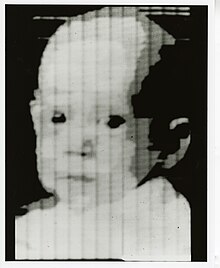
Walden Kirsch as scanned into the SEAC estimator in 1957
In 1957, a team led past Russell A. Kirsch at the National Institute of Standards and Technology adult a binary digital version of an existing technology, the wirephoto drum scanner, so that alphanumeric characters, diagrams, photographs and other graphics could exist transferred into digital computer retention. One of the outset photographs scanned was a picture of Kirsch's infant son Walden. The resolution was 176x176 pixels with only one bit per pixel, i.east., stark blackness and white with no intermediate gray tones, but by combining multiple scans of the photo done with unlike black-white threshold settings, grayscale information could too be acquired.[59]
The accuse-coupled device (CCD) is the image-capturing optoelectronic component in first-generation digital cameras. It was invented in 1969 by Willard Boyle and George East. Smith at AT&T Bell Labs as a memory device. The lab was working on the Picturephone and on the development of semiconductor bubble memory. Merging these two initiatives, Boyle and Smith conceived of the design of what they termed "Charge 'Bubble' Devices". The essence of the pattern was the ability to transfer charge along the surface of a semiconductor. It was Dr. Michael Tompsett from Bell Labs even so, who discovered that the CCD could be used as an imaging sensor. The CCD has increasingly been replaced by the active pixel sensor (APS), commonly used in prison cell telephone cameras. These mobile phone cameras are used by billions of people worldwide, dramatically increasing photographic activeness and textile and also fueling citizen journalism.
- 1973 – Fairchild Semiconductor releases the first large paradigm-capturing CCD chip: 100 rows and 100 columns.[sixty]
- 1975 – Bryce Bayer of Kodak develops the Bayer filter mosaic pattern for CCD color image sensors
- 1986 – Kodak scientists develop the world's first megapixel sensor.
The web has been a popular medium for storing and sharing photos ever since the first photograph was published on the web by Tim Berners-Lee in 1992 (an image of the CERN house band Les Horribles Cernettes). Since then sites and apps such as Facebook, Flickr, Instagram, Picasa (discontinued in 2016), Imgur and Photobucket have been used by many millions of people to share their pictures.
Gallery of historical photos [edit]
-

Small Wooden box containing uncased primitive daguerreotypes. They are the early work of Dr John Draper and Samuel Morse at NYU in the fall of 1839. A failed image attempt and 4 good images from the box are posted in this gallery.
-

Failed image attempt by John W Draper from the box containing his early efforts at making daguerreotypes at NYU in the fall of 1839
-

Dr John William Draper, long credited as the first person to take an prototype of the homo confront, sitting with his institute experiment , pen in hand, at NYU in the fall of 1839. Daguerreotype past Samuel Morse 1839.
-
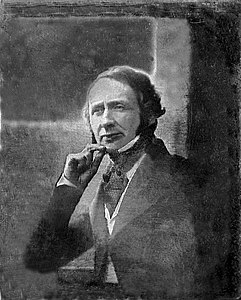
Samuel Morse, Art Professor at NYU in 1839. Daguerreotype by Dr John William Draper 1839.
-

Dr Martyn Paine. Ane Of the founders Of the NYU medical school Daguerreotype by Dr John William Draper 1839.
-

-

-
-

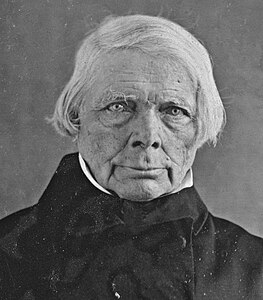
Conrad Heyer at historic period 103 in 1852, possibly the earliest-born American always photographed (built-in 1749)
-

See also [edit]
- History of the camera
- History of Photography (academic journal)
- Albumen print
- History of photographic lens design
- Timeline of photography engineering science
- Outline of photography
- Photography past indigenous peoples of the Americas
- Women photographers
- Moving picture camera
- Instant film
References [edit]
- ^ "The Outset Photograph". www.hrc.utexas.edu . Retrieved 4 Apr 2020.
- ^ a b Hirsch, Robert (two June 2018). Seizing the Light: A History of Photography. McGraw-Colina. ISBN9780697143617 – via Google Books.
- ^ The Michigan Technic 1882 The Genesis of Photography with Hints on Developing
- ^ "photography - Search Online Etymology Dictionary". www.etymonline.com.
- ^ "Did You Know? This is the First-ever Photograph of Human Captured on a Photographic camera". News18 . Retrieved 19 Baronial 2020.
- ^ Jade (xx May 2019). "The History of the Photographic camera". History Things . Retrieved 19 August 2020.
- ^ Gernsheim, Helmut (1986). A concise history of photography. Courier Dover Publications. ISBN 0-486-25128-4
- ^ Batchen (1999). Called-for with Want: The Conception of Photography. ISBN9780262522595.
- ^ "Septem planetarum terrestrium spagirica recensio. Qua perspicue declaratur ratio nominis Hermetici, analogia metallorum cum microcosmo, ..." apud Wilh. Janssonium. 2 June 2018 – via Google Books.
- ^ Eder, Josef Maria (1932). Geschichte der Photographie [History of Photography]. p. 32.
- ^ Sloane, Thomas O'Conor (1895). Facts Worth Knowing Selected Mainly from the Scientific American for Household, Workshop, and Subcontract Embracing Practical and Useful Data for Every Branch of Manufacture. Southward. S. Scranton and Company.
- ^ The title page dated 1719 of a section (of a 1721 volume) containing the original publication can be seen here. In the text Schulze claims he did the experiment ii years earlier
- ^ Bibliotheca Novissima Oberservationum ac Recensionum (in Latin). 1721. pp. 234–240.
- ^ Litchfield, Richard Buckley (1903). Tom Wedgwood, the Get-go Photographer, etc., London, Duckworth and Co. Out of copyright and available gratuitous at archive.org. In Appendix A (pp. 217-227), Litchfield evaluates assertions that Schulze'south experiments should be called photography and includes a complete English language translation (from the original Latin) of Schulze's 1719 account of them as reprinted in 1727.
- ^ Susan Watt (2003). Silver. Marshall Cavendish. pp. 21–. ISBN978-0-7614-1464-3 . Retrieved 28 July 2013.
... But the first person to use this property to produce a photographic paradigm was German physicist Johann Heinrich Schulze.
- ^ de la Roche, Tiphaigne (1760). Giphantie (in French).
- ^ "Tiphaigne de la Roche – Giphantie,1760". wordpress.com. 7 July 2015.
- ^ "Carl Wilhelm Scheele | Biography, Discoveries, & Facts". Encyclopedia Britannica . Retrieved xx August 2020.
- ^ a b c d Litchfield, Richard Buckley (1903). Tom Wedgwood, the First Photographer. Duckworth and Co. pp. 185–205.
- ^ Fulhame, Elizabeth (1794). An essay on combustion, with a view to a new art of dying and painting. Wherein the phlogistic and antiphlogistic hypotheses are proven erroneous. London: Printed for the author, by J. Cooper. Retrieved 2 March 2016.
- ^ Schaaf, Larry J. (1990). "The first fifty years of British photography, 1794-1844". In Pritchard, Michael (ed.). Engineering and fine art: the birth and early on years of photography: the proceedings of the Royal Photographic Historical Group conference 1-3 September 1989. Bath: RPS Historical Grouping. pp. 9–18. ISBN9780951532201.
- ^ Schaaf, Larry J. (1992). Out of the shadows: Herschel, Talbot, & the invention of photography. New Haven: Yale Academy Printing. pp. 23–25. ISBN9780300057058.
- ^ Batchen, Geoffrey (1999). Burning with Desire: The Conception of Photography. MIT Press.
- ^ Litchfield, Richard Buckley (1903). Tom Wedgwood, the First Photographer - Appendix B. Duckworth and Co. pp. 228–240.
- ^ "The First Photograph — Heliography". Archived from the original on 6 Oct 2009. Retrieved 29 September 2009.
from Helmut Gernsheim'south article, "The 150th Ceremony of Photography," in History of Photography, Vol. I, No. ane, Jan 1977: ...In 1822, Niépce coated a glass plate... The sunlight passing through... This first permanent example... was destroyed... some years later.
- ^ a b c "Nicéphore Niépce House Museum inventor of photography - Nicephore Niepce House Photo Museum". world wide web.niepce.org.
- ^ Folpe, Emily Kies (2002). Information technology Happened on Washington Foursquare. Baltimore: Johns Hopkins University Press. p. 94. ISBN0-8018-7088-7.
- ^ a b [1] Past Christine Sutton
- ^ Niépce House Museum: Invention of Photography, Role 3. Retrieved 25 May 2013. The traditional judge of eight or ix hours originated in the 1950s and is based mainly on the fact that sunlight strikes the buildings as if from an arc across the sky, an consequence which several days of continuous exposure would as well produce.
- ^ "Daguerre (1787–1851) and the Invention of Photography". Timeline of Fine art History. Metropolitan Museum of Art. October 2004. Retrieved half dozen May 2008.
- ^ (Arago, François) (1839) "Fixation des images qui se forment au foyer d'une chambre obscure" (Fixing of images formed at the focus of a camera obscura), Comptes rendus, 8 : iv-7.
- ^ Past mid-Feb successful attempts to replicate "Thou. Daguerre's cute discovery", using chemicals on paper, had already taken place in Germany and England: The Times (London), 21 February 1839, p.6.
- ^ e.chiliad., a 9 May 1839 showing to John Herschel, documented by Herschel's letter of the alphabet to WHF Talbot. See the included footnote #i (by Larry Schaaf?) for context. Accessed 11 September 2014.
- ^ Daguerre (1839), pages ane-iv.
- ^ Run across:
- (Arago, François) (1839) "Le daguerreotype", Comptes rendus, 9 : 250-267.
- Daguerre, Historique et description des procédés du daguerréotype et du diorama [History and description of the processes of the daguerreotype and diorama] (Paris, French republic: Alphonse Giroux et Cie., 1839).
- ^ Brazil
- ^ "Cronologia de Hercule Florence". ims.com.br (in Brazilian Portuguese). two June 2017.
- ^ Kossoy, Boris (14 December 2017). The Pioneering Photographic Piece of work of Hercule Florence. ISBN9781315468952.
- ^ John F. W. Herschel (1839) "Note on the art of photography, or the application of the chemical rays of lite to the purposes of pictorial representation," Proceedings of the Purple Society of London, 4 : 131-133. On folio 132 Herschel mentions the apply of hyposulfite.
- ^ Daguerre, Historique et description des procédés du daguerréotype et du diorama [History and description of the processes of the daguerreotype and diorama] (Paris, French republic: Alphonse Giroux et Cie., 1839). On page 11, for example, Daguerre states: "Cette surabondance contribue à donner des tons roux, même en enlevant entièrement l'iode au moyen d'un lavage à l'hyposulfite de soude ou au sel marin." (This overabundance contributes towards giving crimson tones, fifty-fifty while completely removing the iodine past ways of a rinse in sodium hyposulfite or in sea salt.)
- ^ Comeback in photographic pictures, Henry Fox Talbot, United States Patent Role, patent no. 5171, June 26, 1847.
- ^ "Life and work of Janez Puhar | (accessed December 13, 2009)".
- ^ Michael R. Peres (2007). The Focal encyclopedia of photography: digital imaging, theory and applications, history, and science. Focal Press. p. 38. ISBN978-0-240-80740-ix.
- ^ Richard G. Condon (1989). "The History and Development of Arctic Photography". Arctic Anthropology. 26 (i): 52. JSTOR 40316177.
- ^ The Complete Works of Lewis Carroll. Random House Modern Library
- ^ Levenson, G. I. P (May 1993). "Berkeley, overlooked man of photo science". Photographic Journal. 133 (4): 169–71.
- ^ Gillespie, Sarah Kate (2016). The Early American Daguearreotype: Cross Currents in Art and Technology. Cambridge: Massachusetts: MIT Printing. ISBN9780262034104.
- ^ Koehler, Jeff (2015). "Capturing the Light of the Nile". Saudi Aramco Globe. Vol. 66, no. 6. Aramco Services Visitor. pp. 16–23. Retrieved 11 Dec 2018.
- ^ Loke, Margarett (7 July 2000). "Photography review; In a John Brownish Portrait, The Essence of a Militant". The New York Times . Retrieved 16 March 2007.
- ^ Eric Hosking; Harold Lowes (1947), Masterpieces of Bird Photography, William Collins, Sons, p. ix, ASIN B000O8CPQK, Wikidata Q108533626
- ^ "History". Kodak-History . Retrieved 2021-12-04 .
{{cite spider web}}: CS1 maint: url-status (link) - ^ a b "First 3D photo - the technology". benbeck.co.uk . Retrieved vii March 2020.
- ^ Belgique, Académie Royale des Sciences, des Lettres et des Beaux-Arts de (1849). Bulletins de l'Académie Royale des Sciences, des Lettres et des Beaux-Arts de Belgique (in French). Hayez.
- ^ "Stereoscopic Daguerreotype Portrait of Faraday | Scientific discipline Museum Grouping Collection". collection.sciencemuseumgroup.org.united kingdom of great britain and northern ireland . Retrieved 7 March 2020.
- ^ James Clerk Maxwell (2003). The Scientific Papers of James Clerk Maxwell. Courier Dover Publications. p. 449. ISBN0-486-49560-4.
- ^ Brian, Coe (1976). The Nativity of Photography. Ash & Grant. ISBN0-904069-07-9.
- ^ a b Douglas R. Nickel (1992). "Autochromes by Clarence H. White". Record of the Fine art Museum, Princeton University. 2. 51 (two): 31–32. doi:10.2307/3774691. JSTOR 3774691.
- ^ "Potatoes to Pictures". The American Museum of Photography. The American Photography Museum.
- ^ "SEAC and the Start of Image Processing at the National Bureau of Standards – Earliest Paradigm Processing". nist.gov. Archived from the original on 19 July 2014. Retrieved 27 February 2014.
- ^ Janesick, James R (2001). Scientific Charge Coupled Devices. SPIE Press. ISBN0-8194-3698-4.
Further reading [edit]
- Hannavy, John. Encyclopedia of Nineteenth-Century Photography, 5 volumes
- Clerc, L.P. Photography Theory and Practice, being an English edition of "La Technique Photographique"
External links [edit]
- . Encyclopædia Britannica. Vol. 21 (11th ed.). 1911. pp. 845–522.
- The Silver Canvas: Daguerreotype Masterpieces from the J. Paul Getty Museum Bates Lowry, Isabel Barrett Lowry 1998
- A History of Photography from its Beginnings Till the 1920s past Dr. Robert Leggat, at present hosted by Dr Michael Prichard
- The Kickoff Photo at The University of Texas at Austin
Source: https://en.wikipedia.org/wiki/History_of_photography
Posted by: cabralbarbence.blogspot.com
0 Response to "How To Make A Camera Obscura Tent"
Post a Comment